Defending Academic Freedom and Democracy
Heather McCambly selected for three fellowships designed to safeguard the future of higher education
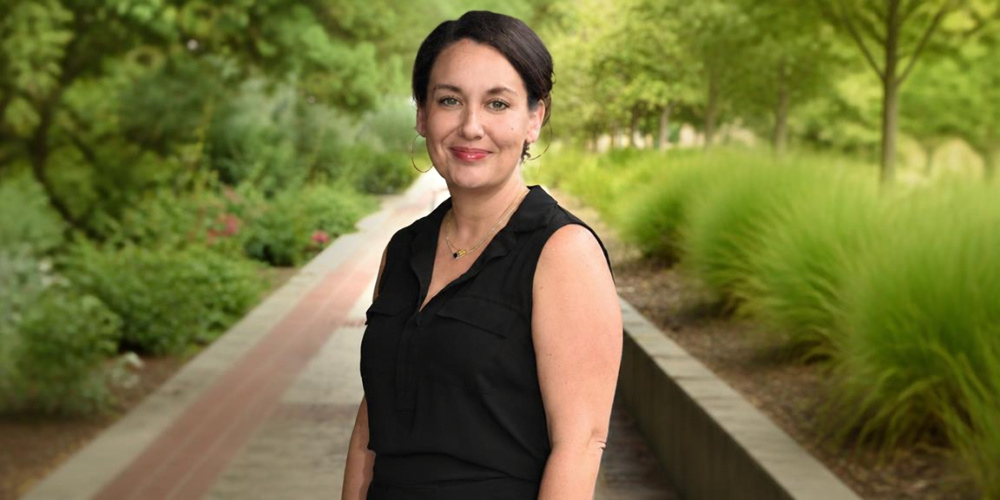
School of Education Associate Professor Heather McCambly is alarmed by what she sees as growing threats to American democracy and academic freedom at the nation’s colleges and universities.
Those threats, she says, are taking many forms: increased restrictions on tenure, weakened shared governance, federal policy changes affecting research funding and student financial aid, greater influence by non-faculty over curriculum, and a political climate that can discourage free expression.
Through several new fellowships, McCambly will have an opportunity to examine these challenges and help shape potential responses. She has been selected for the Alliance for Higher Education’s inaugural fellowship program, which brings together research and policy work to strengthen higher education’s role in American democracy.
During the yearlong fellowship, McCambly and six other scholars will work in action hubs focused on major challenges facing higher education. Her primary focus will be on policy changes affecting federal science funding.
“If higher education is a pillar of democracy, then we should want equal representation and participation in higher education as an important pathway to civic engagement and leadership,” said McCambly, who is also the school’s associate chair of the Department of Educational Foundations, Organizations, and Policy (EFOP).
The Alliance fellows will connect research, practice, and policy across three core areas: the freedom to teach, learn, and conduct research without censorship; institutional autonomy in higher education; and fair opportunity for all.
Fighting to Preserve Faculty Governance
McCambly was also selected this year for the American Association of University Professors (AAUP) Center for the Defense of Academic Freedom Fellowship.
During the two-year fellowship, McCambly will examine the growing presence of centers and institutes at universities that are framed around seemingly nonpartisan issues, such as civic engagement or intellectual freedom, but are associated with conservative or right-leaning ideologies. Some of these centers offer their own academic courses or play a role in developing and implementing curriculum across the university.
“It doesn’t immediately sound like an academic freedom or faculty governance issue, but many of these centers are being created and staffed outside the bounds of faculty governance–meaning those hired to run these centers may not be vetted according to the rigor of the disciplines, which should act as a check against purely political appointments and funders’ ideological priorities,” McCambly said.
She said concerns can also arise when courses offered by these centers are mandated by state legislatures as part of general education requirements, potentially displacing other areas of study with no faculty oversight.
“When courses offered by these civic learning centers are embedded into gen ed requirements, things like ethnic studies or women’s studies courses—if they are not being canceled or closed—are being removed as an option for gen ed, which can be a politically motivated death sentence for those departments,” McCambly said.
Her third fellowship, also awarded this year, is with the University of California’s National Center for Free Speech and Civic Engagement. (The center was founded in 2017, before the rise in covertly partisan centers.)
In this project, McCambly approaches academic freedom from another angle: the role of collective bargaining and faculty unions. Working with Román Liera of Montclair State University, McCambly is conducting a research project titled “Bargaining for Democracy: Faculty Unions, the BCG Framework, and the Defense of Civic Education.”
“We’re trying to learn things about collective bargaining that might offer a more expansive view on how collective bargaining can work to shore up higher education,” McCambly said.
For McCambly, that work is especially important at a time when she believes faculty members have lost influence over some university decisions.
“Because shared governance has gotten so eroded at universities, we no longer have a lot of say at many universities over things like curriculum. One of the main avenues back is collective bargaining,” McCambly said.
What’s at Stake
McCambly sees parallels between today’s challenges to higher education and earlier periods when academic freedom came under political pressure, including the Red Scare and McCarthyism of the 1950s. More recently, she points to Hungary, where the government of Viktor Orbán exerted increasing control over universities, undermining institutional autonomy and academic freedom.
“The long game is to control what young people come to know and to silence dissenters more broadly around their bigger goals,” McCambly said.
She also cautions against viewing declining public confidence in higher education in isolation. Trust has eroded across a range of American institutions, including government, education, science, health care, and the media.
While McCambly acknowledges that higher education has room for improvement, she worries that current policy changes could have consequences far beyond college campuses. Limits on federal research support, she said, can affect scientific progress in areas that directly touch people’s lives, including disease prevention, diagnosis, treatment, and care.
Her three fellowships give McCambly an opportunity to study and respond to these issues. But she hopes students and colleagues will recognize that they, too, have a stake in what happens next.
“I hope they get mad that their education is being played with not over earnest concerns about quality, but as a means for ideological control,” she said.