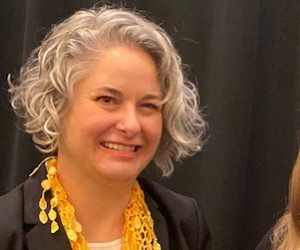

Meet April Peters, Professor and Chair of the Department of Teaching, Learning, and Leading (Q&A)
Peters joined the School of Education faculty in August 2026
This fall, the School of Education rang in the new semester with new faculty leadership. April L. Peters is professor and chair of the Department of Teaching, Learning and Leading (TLL). Her research focuses on school leadership in urban centers, the cultivation of early career school leaders, university-secondary school partnerships, and supporting women in leadership. She joins Pitt from the University of Houston.
We asked Peters about her path to becoming an educator, what she hopes students learn in her classes, and advice for those curious about entering this rewarding profession.
What pulled you from the classroom into school social work and leadership?
I was always interested in social work, even when I was an undergraduate at Northwestern. I had a practicum, which eventually turned into a part-time job, working with homeless populations in and near Chicago. So you could say that social work was my first love. I fell into teaching because of my love of children. Once I got into it, though, I fell in love with teaching.
After I finished my commitment with Teach for America, I earned an MSW in school social work. I realized how much better I could have been as a teacher if I had had formal social work training. After getting the degree, I searched for jobs that would allow me to do both, and I found a position that did, with leadership responsibilities as well. Eventually, I was offered more leadership opportunities. I viewed these experiences as instrumental to making the learning environment more effective for all children and adults.
How did those roles shape the way you study and teach school leadership?
Those experiences gave me a great perspective on the organizational processes of a school as well as the needs of the people that schools serve. In these roles, I was able to see and experience others’ leadership and to develop some thoughts of my own about what makes it effective.
As a teacher, I learned so much about what teachers need to feel efficacious and about the resources that are important for them to do their jobs well. I also learned the importance of developing relationships with everyone in the school. As a social worker, I came to realize that so many of the presenting behaviors children, and adults, exhibit are attributable to deeper issues. That is why relationship building is so important. These experiences also taught me the value of building trust.
Both positions required hard work, relationship building, a commitment to excellence, and an understanding of processes and procedures. All of that lent itself to my interest in leadership.
What drew you to studying women in school leadership, and what misconception would you like to correct?
I grew curious about women in leadership as I learned how few women were leading schools, particularly at the middle and high school levels and at the district level. The research I reviewed indicated that women’s experiences often differed from men’s because of fewer opportunities to obtain such positions, fewer role models, and often a lack of effective mentoring. Many studies reveal that some women lead in ways that are nurturing. It should be noted that not all women lead in the same way.
On a personal note, I was particularly interested in becoming a high school principal. I wanted the experience of leading in a secondary school, and I fully expected to be one of only a few women. However, when I attended my first high school principal meeting in my district, I was pleasantly surprised to find that nearly all of the principals were women. I realized that the research I had encountered, while generalizable, wasn’t particular to the district I worked in. It was an interesting fact to grapple with as I tried to apply what I had learned from research and my dissertation study to my lived experience as a school leader.
What does an effective university-district partnership look like day to day, compared to one that exists only on paper?
University-district partnerships are not unlike other relationships. They are most effective when they are built on trust and communication. Day to day, there are ups and downs as the two entities focus on their distinct priorities, but their missions often intersect, and the best partnerships function in that space.
Often, these partnerships are characterized by the university taking the lead and suggesting what courses should be taught, and by whom, to prepare leaders and teachers. The most effective partnerships, however, require each entity to have “skin in the game.” If the university is preparing educators, it should be accountable for doing so effectively. That requires communication with the district partner to understand the district’s intractable problems of practice, and then working together to address them. It also requires dedicated time to plan together.
In my experience, my previous university and our district partner also completed admissions cycles together, so that students admitted to our cohorts were approved by both the district and the university. We also identified qualified instructors from both the university and the district. The partnership was time-consuming, but well worth it. Finally, it could not have happened without the express support of the district superintendent and our dean.
What do you hope students take away from your courses about how they’ll lead in the field?
I hope students will be inspired to always be reflective about their leadership practice. In my philosophy, leadership is about relationship building, trust, communication, and transparent processes. I hope my students will be committed to engaging in these activities with the goal of creating and sustaining effective schools for children.
What might surprise your students and colleagues about you?
I was in a local theater production of a popular musical a few years back. Yes, I had to sing, dance, and act. Fun times.
What do you like to do outside of research and teaching?
I like to read, bake, and play board games. I like to explore new activities with my family. I love music, and I love to dance.
What advice would you give someone just starting out as a school administrator?
I would give them the same advice my mother, a retired teacher, gave me when I was first starting out. She said never make important decisions as a committee of one. That is not to say that a nine-person committee must convene around every decision. It is to say that one needs to be reflective and seek expert guidance when making decisions that shape and affect the work and personal lives of others.