Associate Professor Max Schuster Releases New Book on Civic Learning in Higher Education
Charting a path rooted in “hopeful resilience” for democracy in higher education
What does it mean to teach democracy when democracy itself feels under pressure? That’s the central question driving Maximilian Schuster‘s latest book.
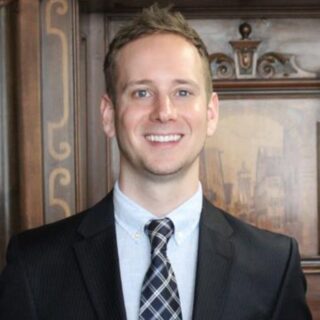
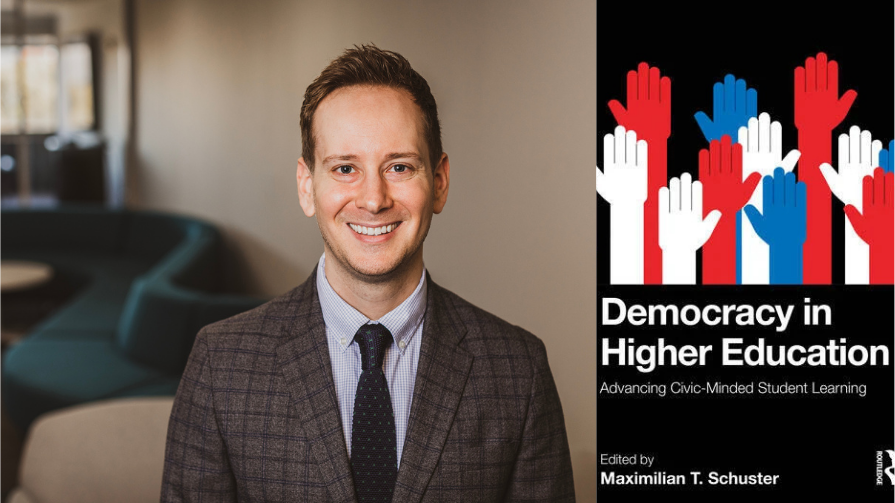
Schuster, associate chair and associate professor of practice in the Department of Educational Foundations, Organizations, and Policy at the School of Education, is the editor of Democracy in Higher Education: Advancing Civic-Minded Student Learning, published by Routledge, and author of several chapters in the volume.
The book offers a forward-looking framework for faculty, student affairs professionals, and community engagement practitioners seeking to foster civic learning across their institutions in a practical manner.
From a 2015 Study to a National Conversation
Schuster’s path to the book began more than a decade ago during a research study examining how students transition into higher education.
Along with the typical anxieties of starting college—making friends, adjusting to new academic expectations, and finding their footing on campus—students kept bringing up something else: the 2016 presidential election and the weight it was placing on their daily lives.
“A lot of times, we think of higher education as a bubble isolated from the outside world,” Schuster said. “What students began telling us about 10 years ago was that the broader social and political context very much affects their experience.”
Two more presidential election cycles later and amid a dramatically shifting federal landscape, Schuster has continued researching the ways political context presses upon higher education and the ways institutions prepare students to navigate it.
The book is the culmination of that work, written not as a retrospective but as an actionable resource for the present moment.
“What students were telling us 10 years ago, we see happening in real time today,” Schuster said.
A Framework for Civic-Minded Learning
At its core, the book advances a multi-pronged framework for “civic-minded student learning,” a concept that goes well beyond a college making space for voter registration drives or election-season programming. The framework is designed to be adaptable and can be applied at the department level, across general education curricula, and throughout student affairs programs.
The framework makes the case that local partnerships and service-learning opportunities are powerful laboratories for civic learning, particularly as students begin to formally connect with civic life at the national level.
The final sections of the framework ask educators to look critically at what they’re already doing, and whether it is still serving students well.
“We’re not saying to layer civic learning on top of everything else but rather to turn the conversation toward models that may be overdue for renewal,” he said.
Schuster says the narrative of the book carries a “hopeful resilience”— an acknowledgment of the real challenges facing higher education paired with a clear-eyed belief that a path forward is possible, individually and institutionally
A Pitt-wide Collaboration
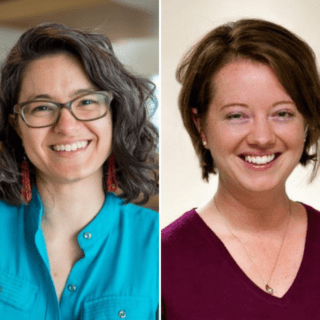
School of Education faculty members Mariko Yoshisato Cavey and Hayley Weddle are among the contributors, as is School of Education alumna Jessica Mann (PhD ‘17) and School of Education Higher Education PhD student Samantha Shaw.
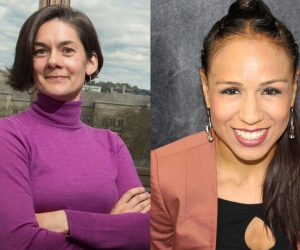
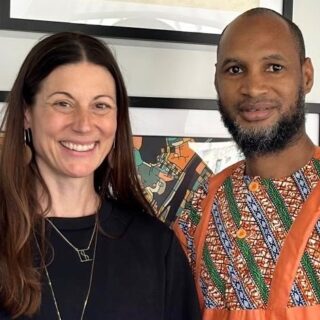
Also contributing are Pitt colleagues Bryan Schultz (global experiences), David V.P. Sanchez (civil and environmental engineering), Kristin Kanthak (political science), Michael R. Glass (sociology and urban studies), and Lina Dostilio (vice chancellor for external relations).
“The book is really a testament to the fantastic collaborators who contributed chapters to it,” Schuster said. “They brought forward-looking, innovative ideas that are poised to reshape the way civic learning happens in higher education.”
Schuster envisions the book as a resource for a broad audience: higher education faculty and staff, graduate students across disciplines, and community members interested in how colleges and universities play a role in civic life.
Schuster is already at work on a second volume focused on civic engagement in student affairs and out-of-classroom experiences. Where the first book largely addresses the academic side of higher education, the follow-up will turn more attention to the extracurricular spaces where so much of student life also occurs.