
Students, Educators Explore Maximizing Value at Transfer Pathways Summit
Third annual summit was hosted by the School of Education
When KC Okoye transferred to the University of Pittsburgh from a nearby community college to study economics, he initially experienced a common feeling among many transfer students: imposter syndrome.
“Taking classes here is different,” he said.
But he soon found his footing — and inspiration. He saw many classmates of color at Pitt thriving academically and socially.
“It’s good to see people who look like you doing big things here. It makes you look in the mirror and see a better version of you, to challenge yourself,” Okoye said.

That part of navigating the transfer experience — making the most of your education — was at the center of this year’s theme at the 2026 Transfer Pathways Summit: “Maximizing Transfer Value: Fueling Student Mobility and Success.”
Held on June 5 at Alumni Hall, the third annual Transfer Pathways Summit brought together nearly 200 people from virtually every school at Pitt and community college practitioners and leaders from 12 institutions across Pennsylvania, New York, New Jersey, and West Virginia. Members of Pittsburgh Public Schools, the Pennsylvania Department of Education, and the Pennsylvania Commission for Community Colleges were also in attendance.
Created by Renée and Richard Goldman Dean Eboni M. Zamani-Gallaher, the annual summit is presented by the School of Education, Office of the Provost, and Pitt Admissions and Financial Aid.
Moving Beyond the Pathway
The student panel, hosted by Shallegra Moye, director of educational enrichment and transition programs and a former Pitt transfer herself, featured Okoye and Paige Lewis, a transfer student from Kent State University. They shared their experiences coming to Pitt and navigating the many layers — financial, academic, logistical, social, and emotional.
“Typically we view transfer as a pathway that students navigate,” said Xueli Wang, the Barbara and Glenn Thompson Professor in Educational Leadership at the University of Wisconsin-Madison, and the keynote speaker at this year’s summit. “But instead we can view transfer as an institutional experience that we collectively build. Then the question becomes, ‘How do we collectively design a transfer experience that is clearer, more connected, and with more possibility?”

Lewis and Okoye had some ideas: a transfer guide; more holistic credit and GPA transfer; and more opportunities to find community through extracurricular activities and affinity groups.
Lewis, a recent graduate of the Applied Developmental Psychology (ADP) bachelor’s program at the School of Education, said her involvement in the Pitt choir and the ADP club anchored her amid a time of tremendous change.
“The support you have from people doing something similar that you love gives you confidence to face challenges” associated with transfer, Lewis said.

Wang’s address acknowledged the experiences of students like Okoye and Lewis, and pointed to the well-meaning but sometimes detrimental practices that can turn students off to exploring transfer pathways.
“I have never come across a transfer professional who wakes up in the morning and wants to create a more confusing student experience. Quite the opposite. They are among the most caring and student centered folks in higher education,” Wang said.
Community College Leaders Weigh In

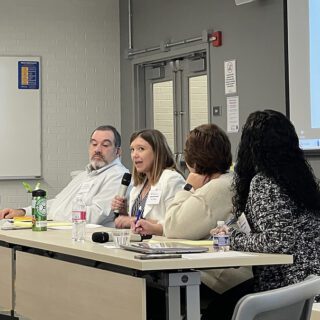
In addition to the student panel and keynote speaker, the Transfer Pathways summit also featured a panel discussion with community college presidents. Moderated by Assistant Professor of Practice Nicholas C. Neupauer, who is a former president of Butler County Community College, the panel included two School of Education alumni: Victoria Bastecki-Perez (MEd ’90, EdD ’95), president of Montgomery County Community College (MCCC), and Christopher Reber (PhD ’87), president of Hudson County Community College (HCCC).
Reber said his college is “life-changing” for students, many of whom are the first in their family to pursue a higher education credential. He said HCCC’s students are often from low-income backgrounds, report food insecurity or homelessness, are racially diverse, and are working full-time. Many are also parents and some speak English as a second language.
“I think the community college is becoming increasingly recognized for its valuable role in higher education,” Reber said.
Bastecki-Perez, a first-generation student herself, said MCCC is an economic engine for the eastern Pennsylvania region since many of its graduates stay local.
“I know our future is bright when I look out at our students,” Bastecki-Perez said.

The Transfer Pathways summit also offered a set of breakout sessions from Pitt staff and administrators. It concluded with a surprise, when Zamani-Gallaher presented Marc L. Harding, who recently retired from his role as Pitt’s vice provost for enrollment and chief enrollment officer, with the inaugural Excellence in Transfer Student Success Award. The award will be given out at future summits and will bear his name in the future.
As Okoye and Lewis’s stories showed, when institutions invest in intentional transfer pathways, students don’t just arrive — they succeed.